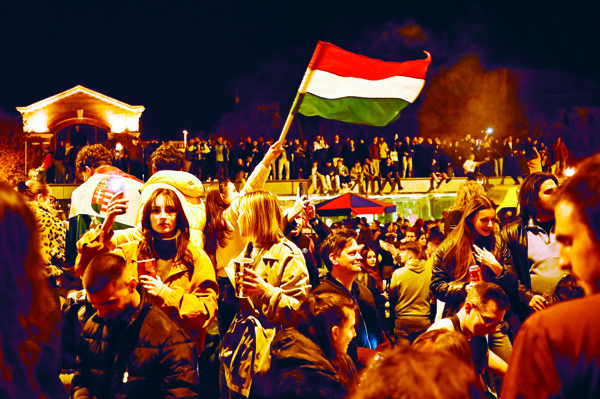
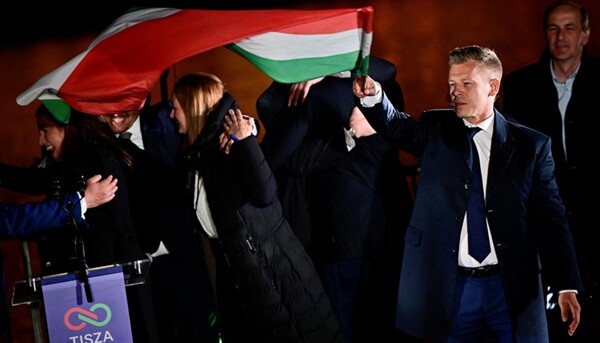
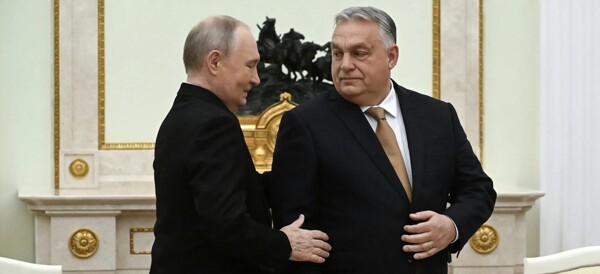
For Trump, Netanyahu, Abascal, Milei, Giorgia Meloni, and much of the international far-right, Orbán was more than an ally: he was a model. From Budapest, he financed think tanks, ideological networks, and like-minded political projects. His regime exported the idea that the far-right could stop being a protest force and transform into a stable system of power. What just happened is a political and symbolic blow to that constellation. Why did it fall? The first lesson is that governing wears on everyone, but it wears more on the far-right. Campaign effectiveness, the creation of grievances, and the emotional simplification of politics have not translated into competence in managing public services and producing inclusive well-being. Orbán promised order, sovereignty, and security; he ended up delivering decay, corruption, and stagnation. To this wear and tear was added a decisive moral fracture. The scandal of the 2024 presidential pardon for a person convicted of covering up sexual abuse of minors pierced the heart of the Orbanist narrative. The government, the 'guardian of the family,' was exposed in a devastating hypocrisy. That's when Péter Magyar appeared, a former insider, ex-husband of the then Minister of Justice, capable of denouncing the rottenness of Fidesz from within with credibility that the traditional opposition had not achieved. Orbán was not defeated by a stranger: he was wounded by a rupture in his own world. The economy finished the job. But what happened there on April 12th could alter the political climate of the West. Viktor Orbán, after sixteen years in power, didn't just lose an election: he lost the most successful, durable, and influential illiberal experiment in the European Union. The Tisza party, led by Péter Magyar, obtained more than 53% of the vote, won 95 of the 106 districts, and secured 138 of the 199 parliamentary seats. This applies to Trump, to Bolsonarism, and also to Orbán. Turnout reached 79.5%. To oust Orbán, it wasn't enough to defeat him: it was necessary to overwhelm a system designed to prevent alternation, and it happened. Orbán was admired by the global new right because he seemed to have solved a central dilemma: how to hollow out democracy from within while preserving its forms. His government kept the ballot boxes while colonizing the courts, redrawing districts, subjugating the media, disciplining universities, and turning the state into a patronage machine. But the most profound damage it inflicts is on Western civilization: the gradual erosion of its liberal, pluralist, and democratic values. That is why Hungary represents, for now, a pause in that drift. Magyar arrives with the supermajority needed to dismantle Orbanism, but must resist the temptation to retain concentrated power. The Hungarian election is a huge, but not definitive, victory. In a European key, the result is a relief. Hungary ceased to be a functional liberal democracy and became an electoral autocracy with a sovereignist vocabulary. That is why its fall transcends it. Magyar came from the very universe of Fidesz. The same thing happens, with its differences, in the MAGA movement, in Spain, or in other radical right-wing movements: when power becomes too personalized, it incubates its own rebellions. Third lesson: an electoral defeat is not equivalent to a historical defeat. Far-right leaders have more lives than a cat. Hungary had become the main internal saboteur of the EU. Orbán hindered every attempt to financially and militarily support Ukraine, eroded the sanctions regime against Russia, and used his position to blackmail Brussels. His defeat objectively weakens Moscow's position within the EU, although Hungarian society maintains a complex relationship with Ukraine and will not support an unconditional alignment with Zelenskyy. Trump threatened to erase Persian civilization in one night of bombing. Orbán justified his closeness to Moscow with the argument of energy pragmatism. Hungary demonstrates that the far-right can be contained. Hungary doesn't weigh too heavily in the European economy, and its population barely equals that of Mexico City without its metropolitan area. The material promise of the regime fell apart; it ended up functioning as a mechanism for extracting rents for those close to power. Second lesson: the far-right also wears out due to its internal fractures. It presents itself as a compact bloc, but its Achilles' heel lies in rivalries, desertions, and settling of scores among its own. Russia seemed to guarantee cheap energy. But in 2026, fuels in Hungary cost 18% more than in neighboring countries like the Czech Republic, which did move away from Russian oil. They can lose the government without losing power altogether. Now it remains to be seen if it can be dismantled. Suggested reading: 'Last Day in Budapest' by Sándor Márai (Salamandra). Thanks, LGCH.

Orbán's Fall: The End of a Model for the Far-Right
The opposition's victory in Hungary is a blow to the Orbán model, which he presented to global far-right figures. An analysis of the reasons for the regime's fall and its significance for Europe and the West.