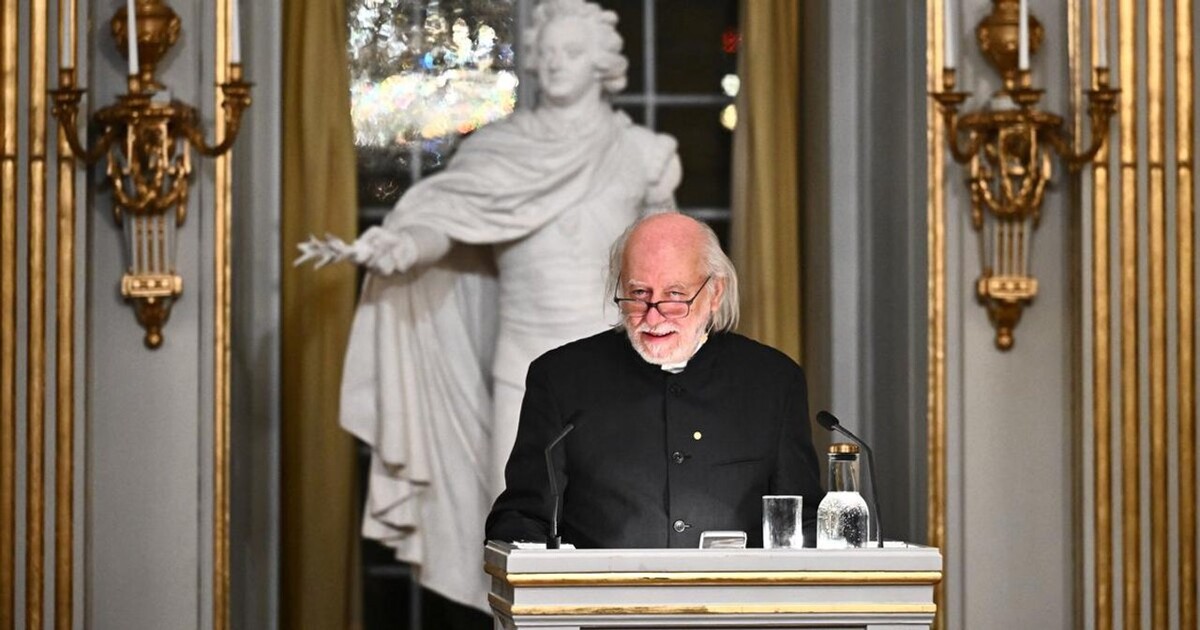
László Krasznahorkai, who won the Nobel Prize in Literature, turned his acceptance speech into a stern warning about the direction of humanity. He recalled that at the age of 19, he dropped out of law school and lived on the street to understand the excluded, an experience that decisively marked his literature. Krasznahorkai evoked an episode experienced in the Berlin metro, where he saw a homeless man trying to urinate on the tracks before being surprised by a policeman. According to his explanation, his initial intention was to dedicate the text to hope, but he decided to modify it upon perceiving that “the reserves of hope had been completely exhausted.” The writer defined these “new angels” as figures who “walk among us in street clothes” and who break in “in a disturbing way” into different areas of daily life. He recounted that years after publishing Satantango, he felt he had to improve his style and wrote another book, and so on. He added that he never wanted to become a writer: “I didn't want to be anyone.” His public presence was particularly celebrated due to his health problems, which limit his schedule. From that premise, he promoted a defense of those who live “on the margins,” reclaiming their dignity and innocence, two themes that have run through his work. The author of Satantango and Melancholy of Resistance spoke of “new angels without wings” who are “seizing the space and time” of people, and among them he cited the billionaire Elon Musk. That scene led him to formulate the question he rescues in his speech: “Human being, surprising creature, who are you?”. From there, he traced a reflection without hope: he recalled the advances of humanity—the wheel, fire, cooperation, empathy—and lamented that suddenly “you started to believe in nothing” and to destroy everything with the devices you created. The author also referred to his own work, marked by the permanent search for precision. “My life is a permanent correction,” he affirmed, and confessed that Franz Kafka is his literary hero. Buenos Aires, December 8 (NA)–László Krasznahorkai's Nobel Prize in Literature acceptance speech became a stern warning about the direction of humanity. Krasznahorkai is the second Hungarian author to receive the Nobel Prize in Literature, after Imre Kertész, distinguished in 2002 and whom he considered “a great friend and a fundamental literary influence.”