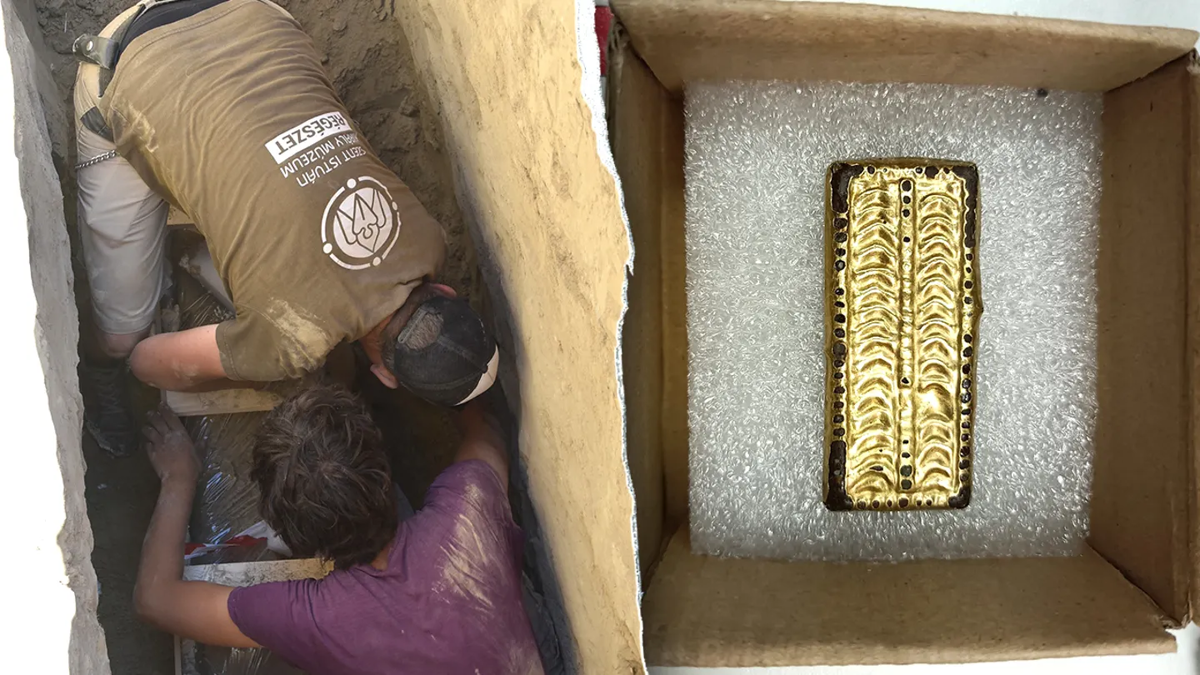
Budapest, December 1, 2025 – Total News Agency-TNA-An archaeological discovery of enormous historical value has come to light in Hungary with the identification of a 1,300-year-old tomb belonging to a high-status warrior of the ancient Avar people, a nomadic civilization from Central Asia that dominated Central and Southern Europe during the High Middle Ages.
Found less than two meters deep, the tomb dates to approximately 670-690 AD, right in the Middle Avar Period. Although it was discovered in August, authorities kept the find under wraps until preliminary evaluations and conservation studies were completed.
Archaeologists noted that the body had been disturbed some time after burial: the position of the head, chest, and abdomen showed clear displacements. The hypothesis that it was reopened for ritual purposes, rather than desecration, is reinforced by the fact that the most valuable objects—weapons, jewelry, and belt fittings—remained intact.
The funerary inventory revealed an extraordinary collection: a long knife, silver belt ornaments, braided golden rings, an earring, and, above all, a sabre in an unusual state of preservation. Arrowheads, silver saddle mounts, and the long knife remained in place, reinforcing the theory of a ritual and not a desecration.
The find includes an exceptionally well-preserved sabre, one of only 80 recorded from that period, along with jewels and ornaments that confirm the social relevance of the individual buried. The team required a special technique to extract the sabre without damaging it. After centuries of corrosion, it now weighs only 1.3 pounds, though it would have been considerably heavier originally.
Lead archaeologist Frigyes Szücsi explained that this weapon was a symbol of elite status in Avar society: “Only high-ranking warriors had sabres, as it was the most expensive weapon of the time.” He added that “this is one of the oldest sabres of this type,” appearing simultaneously in the Carpathian Basin and Eastern Europe during the second half of the 7th century.
Analysis of the tomb suggests the ritual reopening occurred at least a decade after burial, when the bones were no longer held together by connective tissue, but still within Avar times, as the tomb's marker—a mound or wooden post—would have still been visible.
Researchers complemented the fieldwork with satellite technology, identifying variations in the crops over the deep graves, where the soil takes on a darker green hue. This method allowed them to outline the entire cemetery and detect potential unexplored areas.
The discovery of the Avar warrior stands out as one of the most significant of the year due to its uniqueness and the window it opens into a civilization whose history still holds large areas of shadow. His intact find constitutes, according to experts, a key piece to understand the technological and military evolution of Eurasian nomadic peoples.
The Museum of King Stephen in Székesfehérvár announced the discovery after months of analysis. The Avars' material culture, especially their weapons, reflects a world of mobile military elites, Eurasian influences, and a hierarchical social structure. This find adds new pieces to the historical puzzle of the Avars, who dominated vast regions of Central Europe until their decline after the campaigns of Charlemagne.
Hungary, rich in archaeological heritage, has been the scene of several recent discoveries, including unexpected problems like an insect plague that threatened the historic library of a monastery in Pannonhalma. According to Szücsi, the technique offers a “great opportunity” to map unknown funeral sites of the Avar period, given the wide territorial dispersion this people once had.